

Commercialization Readiness
Regulatory Success Does Not Necessarily Mean Commercial Readiness
Healthcare innovators can successfully advance through scientific development and regulatory clearance while still facing significant uncertainty about what happens next.
Will payers recognize sufficient value?
Will clinicians adopt the innovation?
Is the evidence aligned with stakeholder expectations?
What could prevent coverage or adoption?
These questions cannot always be answered from within the organization.
Better commercialization decisions require visibility into the perspectives of the stakeholders who will influence what happens next.
“In our engagement, key commercialization considerations were raised from each panelist’s unique perspective. Thornhill Medical participated in all meetings to learn firsthand about panelists’ perceptions and concerns, informing strategy. The process also included valuable economic analyses critical for market success.”
The Challenge After Regulatory Clearance
Regulatory clearance represents a major achievement.
But it does not resolve the commercialization decisions that follow.
Payers evaluate evidence, value, and coverage.
Clinicians consider clinical utility, workflow, and adoption.
Healthcare organizations consider implementation and economic impact.
An organization can therefore be scientifically accomplished and regulatorily prepared while still facing significant commercialization uncertainty.
Independent research demonstrates the consequences of this broader challenge.


Evidence in Practice
Scientific success does not guarantee commercialization success.
A Stanford-led study published in JAMA Health Forum found that approximately only 44% of novel FDA-approved technologies achieved meaningful Medicare reimbursement, while requiring a median of 5.7 years to obtain broad coverage.
Regulatory clearance may open the door to the market.
It does not determine what happens next.
From Uncertainty to Readiness
Commercialization uncertainty is inherent in healthcare innovation.
The executive challenge is not to eliminate it.
It is to understand the uncertainties that matter while there is still time to make informed decisions.
This raises a broader management question:
What enables organizations to make better commercialization decisions when critical uncertainties remain?
EXCITE’s experience addressing that question has shaped our evolving understanding of Commercialization Readiness.


An Emerging Executive Management Discipline
EXCITE was established in 2016 to address a recurring commercialization challenge.
Medical technology companies were advancing through regulatory clearance yet often lacked the opportunity to understand, in depth, the expectations of the payers and clinical experts whose decisions would influence coverage and adoption.
The Evidence & Technology Review was developed to address that gap.
As organizations engaged directly with independent U.S. payer and clinical stakeholders, recurring patterns began to emerge in how they understood evidence expectations, challenged assumptions, refined strategic priorities, and prepared for commercialization decisions.
Those observations have shaped what EXCITE now describes as Commercialization Readiness.
What We Mean by Commercialization Readiness
Commercialization Readiness is not a regulatory milestone.
It is not a reimbursement outcome.
It is not a product launch checklist.
It is an organizational capability:
The ability to make better-informed commercialization decisions by systematically integrating independent stakeholder perspectives into executive planning.
Commercialization Readiness does not eliminate uncertainty.
It strengthens an organization’s ability to navigate it.

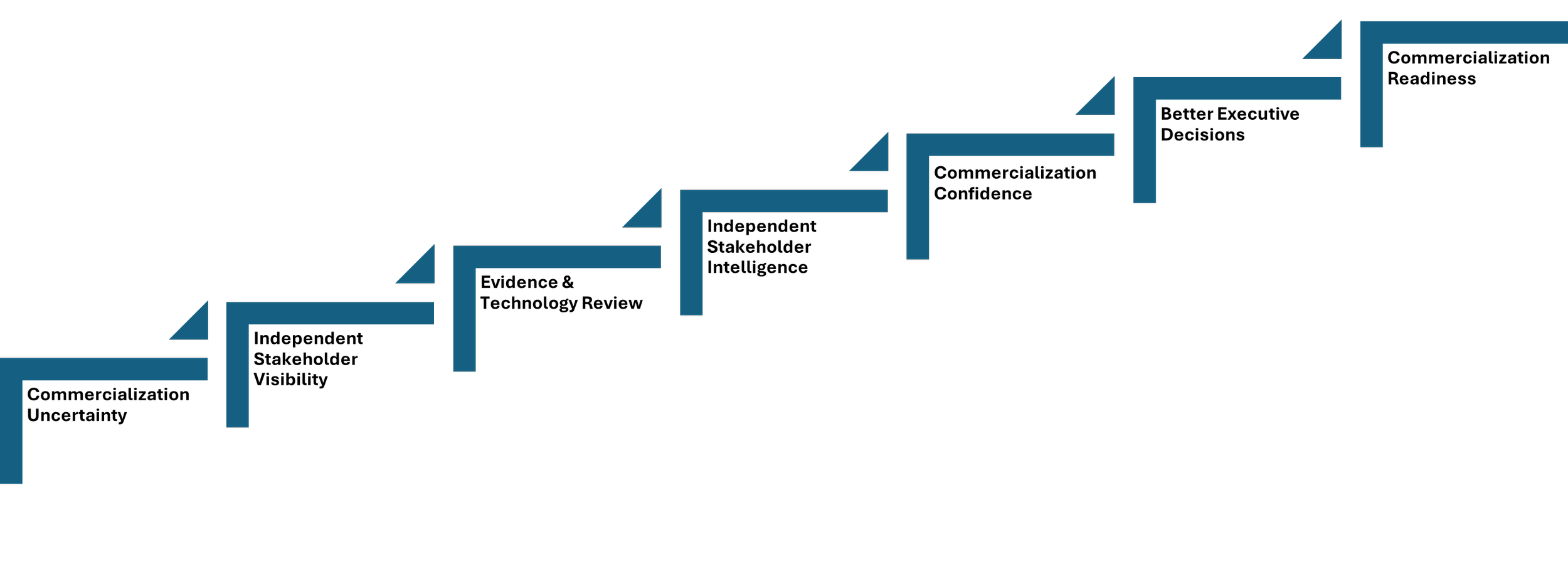
The Commercialization Readiness Journey

Better Decisions Begin with Better Visibility
Organizations cannot control every commercialization outcome.
They can improve the quality of the decisions that influence those outcomes.
That begins with understanding the perspectives of the stakeholders whose decisions will influence reimbursement and clinical adoption.
When those perspectives are gathered systematically, they become Independent Stakeholder Intelligence.
And that is where the Evidence & Technology Review begins.
Start an Executive Conversation
Submit a detailed inquiry to explore how tailored solutions can address specific developmental or operational challenges.